The bridges on the eastern side of Lake Pontchartrain get all the attention, but what are you to do when that action dies down for the summer? Head to the west to catch plenty of fish.
Pelayo grimaced and pointed with his chin toward Artie, who was casting from the bow. I couldn’t see Artie’s face, but Pelayo could. Hence his grimace.
Artie had been uncharacteristically quiet for several minutes now — so I suspected trouble.
“Check out the pelicans,” said Spencer, who was just behind Artie. “Aren’t they beautiful? And to think not too long ago they were threatened with extinction, on the endangered species list. Our state bird, no less! I’m so proud of the way conservation efforts by environmentally conscious groups.”
“They’re PESTS!” Artie erupted. “Wish they were still threatened! Can’t even clean fish in peace anymore! They’re even grabbing fish right off your line nowadays! Next your greenie buddies will be putting coyotes on the threatened list — just watch!”
“The only thing threatened right now is the fish supply for Doc’s birthday bash,” Pelayo injected, trying to defuse the scene.
“Well, you have only yourself to blame!” Artie hooted. “I told y’all this was stupid! Shoot — I can’t figure out how I fell for it myself. ‘Dey wearin’ out the specks at the train bridge!’”
Here Artie added that last bit with an exaggeration of his own yat accent — which is REALLY saying something.
“‘Dey wailin’ on em at the trestles! Dey slaughterin’ da specks at the Twin Spans!’ Good grief!” he said. “It’s the most over-hyped place in Southeast Louisiana fishing!
“Now look at us: Two hours casting with all these fancy-shmanzy plastic baits with one gafftop and a teeeeenzy flounder to show for it!”
Spencer wasn’t budging, though.
“We almost limited out on beautiful specks last week on plastics!” he shot back. “Right here along this very stretch, along with some gorgeous door-mat flounders! Thought I’d do y’all a favor and show you how it’s done. Now look at the thanks I get!”
“Hey, Spence,” growled Artie. “do us a favor, will ya? Don’t do us any more favors — OK! We’ll let you and Doc enjoy your little dilettante B.S. fishing with your little dilettante caps and shirts and wrist bands and little dilettante homemade plastic baits all by yourselves. Ya follow me? ‘Shoulda been here yesterday — blah, blah.’ It’s always the same freakin’ story around here in the eastern Lake — coulda, woulda, shoulda.
“Hit or miss. Feast or famine. The fishing turns on and off like a switch around here. And for some reason, my last three trips out here were always during the off switch! ‘East with plastics?’ No way. I’ll take west with maaaw-ket bait every time!”
Spencer was our gracious host on this emergency fishing trip, and he doesn’t allow dead shrimp on his pristine boat, you see. Live bait’s also a no-no.
Hence our fruitless trip.
For Doc’s looming birthday bash, Artie had reserved his “Uncle Wag” Waguespack’s camp at Manchac, mainly for old times sake.
The place had been a weekend mainstay of ours during our Tiger Land years. We’d hit it often when the Tigers were playing out of town. We’d often “wear-out” the mallards and widgeon in the Prairie in those glorious days, duck-season wise.
Continental duck populations were at their lowest at the time, or so we were told. But now that we look back, our duck hunting was among the hottest of our long duck-hunting careers.
Not that we realized it at the time. And this hot action was smack in the middle of what amounts to a duck dead zone nowadays. Go figure.
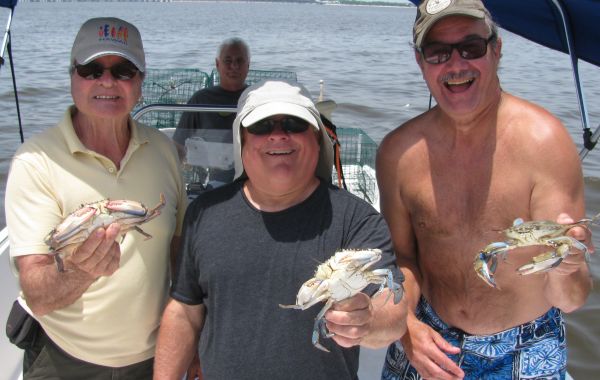
Summer weekends were also “hot” at Uncle Wag’s — and not just climate-wise. What with the fat Manchac crabs from our constant crab-traps runs; the catfish from the trotlines, the croakers and rat reds from fishing the lake’s power lines; and the sheepshead, flounder (and occasional jackfish) from spearfishing/snorkeling around the power lines in the western lake.
With all this, we always dined royally between the constant festivities.
In those disco days, Uncle Wag’s far surpassed some little bait shop/honky-tonk named the The Prop Stop as the area’s “Paaawty Central.”
But, of course, Uncle Wag’s was a private club — and quite an exclusive one, at that. Let any of us detect the signature slide-guitar notes opening Freebird on any sound system and we’re all back at Uncle Wag’s, where the song provided a constant music score.
“Forget it” Groucho Marx famously said. “I don’t want membership in any club that would have me as a member!”
Some of the same spirit defined the members of Uncle Wag’s. And we planned to recapture some of that spirit for Doc’s birthday bash.
Many hurricanes had battered Uncle Wag’s since our glorious Tigerland disco days. But Artie had spent many weekends on repairs, with the always helpful Pelayo lending invaluable advice and assistance in electrical matters between free brewskies.
So the place was primed for Doc’s birthday bash. The crabs, we figured, were a cinch from the traps we’d set in the area during the long weekend. But now the fish for the fryer and grill were looking iffy — thanks to Spencer’s “generosity.”
Our emergency fishing trip came two days before the bash, during the final preparation/sprucing-up trip to Uncle Wag’s camp.
As in the old days, we headed out of Pass Manchac and turned south to cast our maaaw-ket bait around the concrete bases of the deeper power lines.
Dive the shallow Gulf rigs (those in 40 to 70 feet of water), and you see all the fish most Louisiana fishermen pass up on their way to troll for tuna or bottom-fish with gargantuan tackle for red snapper. Spanish mackerel, sheepshead, pompano, puppy drum, spadefish, mangroves — it’s a long list of overlooked, great-fighting, great-eating fish that cram the waters of our shallower rigs.
You see a similar phenomenon while snorkeling the Causeway and western power lines in Lake Pontchartrain. Those obsessed with casting plastics for specks generally miss out on the sheepshead, rat reds, puppy drum, channel cats and croaker that often infest the waters around the above-mentioned structures.
But we were targeting these very fish by bottom-fishing with shrimp, which is to say we were fishing Lake Pontchartrain in the manner it was mostly fished from the time of the Battle of New Orleans until about 30 years ago.
In addition, I’d scooped up a bucketful of little live ditch crawfish. All the fish mentioned above — especially the sheepshead — find these crustaceans irresistible. And it’s not like they’re terribly hard to obtain.
The power lines run from the Williams launch in Kenner to LaPlace, and then turn north, hang a slight right at pass Manchac to just west of the mouth of the Tchefuncte River.
Fishing them is a very similar pattern to Causeway fishing, but during north and westerly winds you’ll find clearer water along the power lines, especially in mid- to late summer when the Tangipahoa, Tchefuncte, Tickfaw, Amite and Blind rivers are down.
Unknown to many, there’s also a “secret fishing hole” in western Lake Pontchartrain just offshore from the mouth of Bayou la Branche near the eastern levee of the Bonnet Carre Spillway that occasionally concentrates the fish. It’s located between power lines 75 and 85, a result of the dredging that filled in the very northwestern corner of the La Branche wetlands for the La Branche Wetlands Marsh Creation Project in 1994.
This “hole” simply means that depths drop from 7 to 8 feet down to 14 to 15 feet. As usual, the saltier water (preferred by rat reds, puppy drum, flounder, specks, etc.) concentrates in these deeper areas.
The edges of this dredge pit — also as usual — tend to concentrate the fish that might already be concentrated in the area.
Your depth finder is your best friend around here.
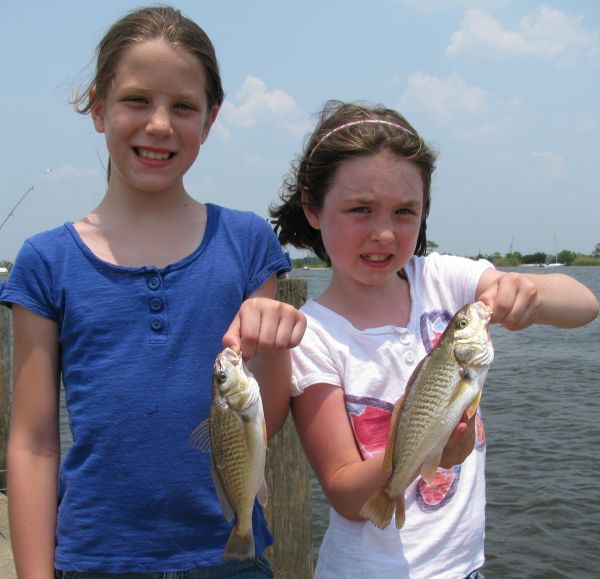
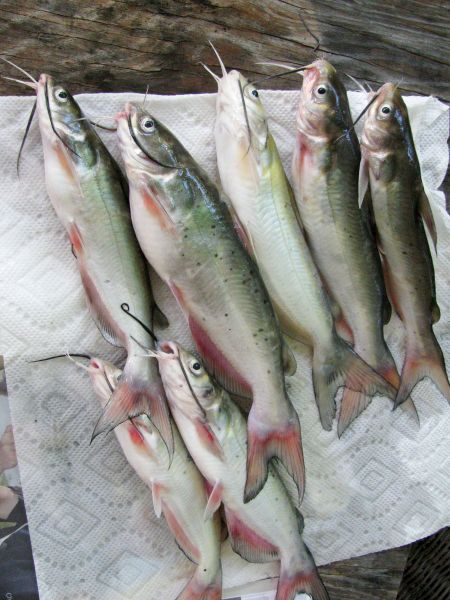
Call us equal-opportunity anglers. By using plain, dead shrimp on smallish (No. 4) hooks, especially in mid-summer when the area rivers have dropped, we haul out rat reds, sheepshead, channel cats, croakers, flounder, gaspergou, bull croakers (measuring 8 to 10 inches long) and little yellow bass — usually no great number of any one of these species — along with little blue and channel cats.
Combined we always have the makings of a dy-no-mite fish fry.
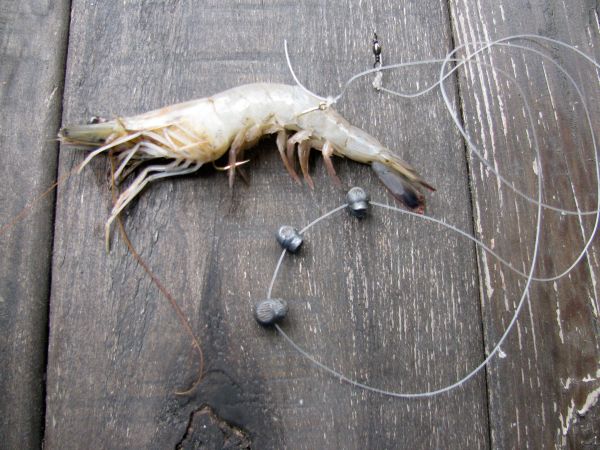
We like to thread a whole fresh shrimp from tail to head on a long-shanked No. 4 hook with a couple of split shots about a foot above it. The little split shots give us just enough casting weight to get the shrimp next to the pilings, but it sinks slowly — and we know from diving that the sheepshead are often at mid depths. Trout and yellow bass, too.
Often they grab the shrimp on the way down.
No anchoring here. The light westerly breeze was perfect for this type of fishing. We simply killed the engine, baited up with shrimp and cast toward the twin pilings as we drifted by.
The small amount of weight allows us to feel the little taps while reeling in the bait slowly along the bottom.
Artie had been doing thet very thing when, WHAM! He set the hook.
The biggest complaint against using dead shrimp in Southeast Louisiana is the likelihood of catching hardheads. But in western Lake Pontchartrain you won’t catch many. It’s amazing — and an utter joy.
When you catch a catfish, it’s invariably a blue or channel cat. They don’t even fight like hardheads; they’re more surface oriented.
Suddenly, Pelayo pointed from next to a furiously reeling Artie. Yep. Some terrified mullet were racing across the surface toward shore.
“Geezum!” Pelayo shouted. “Looks like the jackfish moved in. Usually that also means bull sharks in the area!”
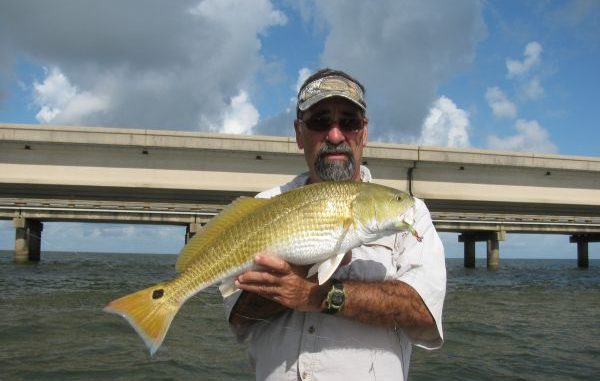
But it was no bull shark on Artie’s line. In short order, Uncle Wag’s nephew was swinging aboard a beaut of a channel cat — about a 2-pounder. He’d hit the maaaw-ket shrimp and was perfect for our cooking plans.
Then Pelayo whooped from the bow.
“No catfish here!” he yelled. “These runs are too long!”
Indeed, this fight had redfish written all over it.
Pelayo held his rod high and looked around for applause — but we were all too busy casting.
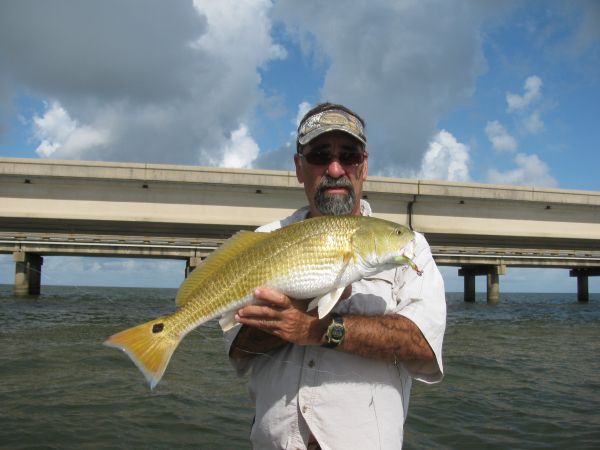
Artie chunked his catfish in the box and grabbed the net as Pelayo’s rat red (about 3 pounds) went on a final spool-screeching run from boatside back under the pilings.
“Tighten the drag!’ Artie counseled right before slipping the net under Pelayo’s fish. Think we’ll grill this one!”
On my third cast, my little crawfish stopped. Then I felt three little taps — then WHAM!
The fight was joined. My spinning reel began singing in short little bursts. Then a long run as I tried muscling the fish toward the boat while lifting it off the bottom.
“NET!” I howled after spotting the fish through the semi-clear greenish water. “FLOUNDER! — and I ain’t swinging this one aboard! NET!!!”
Artie was soon slipping the net under my (borderline) door-mat and swinging it aboard, as I whooped to the heavens and raised by sunburnt arms, mimicking Rocky Balboa in triumph.
Along the next set of power line pilings Pelayo (who’d hooked a little ditch crawfish on his golden Eagle Claw hook) was first to announce success.
“FISH-ON!” he whooped.
His line zipped out but soon came that telltale back-and-forth tug-of-war — so reminiscent of a big bluegill — but which out here usually means ….
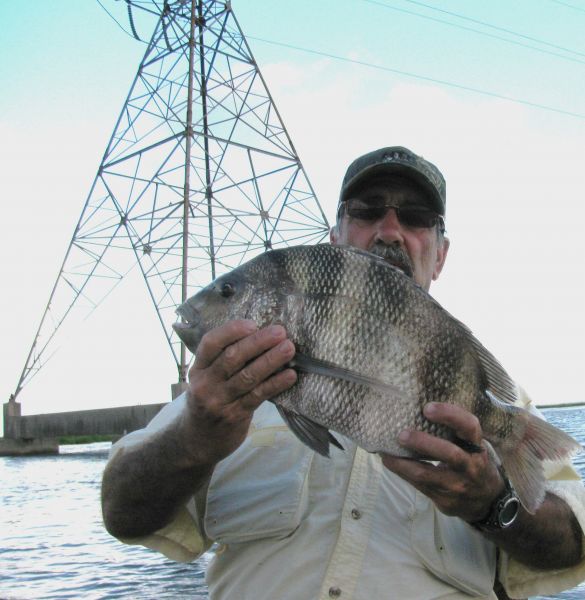
“SHEEPSHEAD!” Artie announced while reaching for the net. “Another one for the grill basket!”
We moved down about three sets of pilings, baited up with little, live crawfish and promptly reeled in three more sheepshead, none more than 4 pounds, none less than 3.
Then a couple more reds, accompanied with four puppy drum.
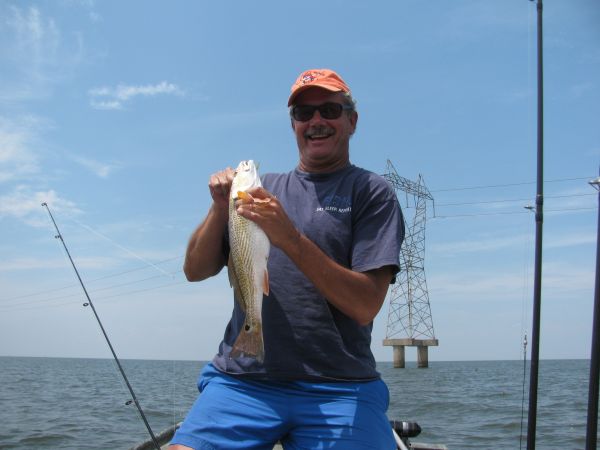
And so it went for the next two hours. We never caught more than three or four fish at a set of pilings. But we never lacked for action — and ended up with a nice mess of five reds, seven sheepshead, four puppy drum, three bull croakers, seven channel cats, three blue cats and a pair of (borderline) door mat flounder.
Achoring at the mouth of North Pass and “going downstairs” (as By HEK used to say) with dead shrimp, we caught three more little blue cats.
A nice little haul by our standards, especially considering the leisurely type of fishing and the short boat haul.
With more-northerly winds, we might have hugged the northern (lee) shore of the lake and fished the “eight mile hump” along the Causeway.
There’s a sound reason for fishing this area: A shell reef, the remnants of an ancient shell island that stretched from inside of Goose Point in the east to a little past the mouth of the Tchefuncte River on the west bisects the Causeway at about 8 miles from the north shore. I saw it on a very old geological map.
The current moves better out in this area, too. We’d always notice it while snorkeling along the pilings spearfishing for sheepshead and the odd flounder.
From about 5 miles to shore, there’s not much current, hence the water’s clear along the bottom. Out toward the middle of the lake, the bottom gets stirred up by the current. And, of course, a moving current’s what you want for most lake fishing.
We might have also dipped a few lines at the mouth of the Tchefuncte River, which has been yielding nice bull croakers lately even for bank fishermen.
But we’d caught plenty fish (by our standards) and had plenty of fun.
Docking up back at Uncle Wag’s with our box of fish, we noticed Spencer’s boat was already docked up.
“He got here early,” Artie laughed, while tying up our boat.
Ahhh! Some familiar notes were issuing from the camp’s newly installed (thanks to Artie and Pelayo) outdoor speakers.
“And what’s that I hear?” Artie asked while cupping his ears and pointing toward the speakers.
You guessed it: Freebird!
”What would we do without good ol’ Spence?” Artie laughed.