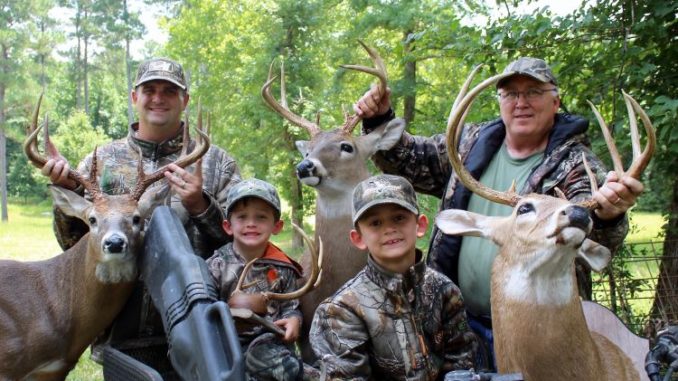
Putting big bucks on the wall is a tradition with this North Louisiana family. Here are the steps they take to consistently make it happen.
The rut won’t start for six to eight weeks now in the deer woods of Union Parish. But one family of successful deer hunters is already make plans and preparations for being there when it happens.
That includes monitoring game cameras in strategic locations, finishing up stand preparations and double-checking equipment.
History shows it’s a good bet all that planning will yield results — mainly more trophy mounts on the wall. The Jones family has deep roots in the parish, hunting their old home area and surrounding property for half a century. Started by Brooks Jones, then his son, Scott, and now grandson Ben and his two young sons, that tradition is something they value deeply.

“I can remember the fun I had with my grandad, Brooks, and it’s something we intend to just keep passing down the line,” said Ben, a senior vice president at nearby Marion State Bank. “We’ve killed a lot of deer and had a lifetime of experiences. Most of our deer hunting stories are about the big ones we’ve killed, but the little things are important, too. I still get ribbed about my early years of going with Papaw Brooks. I’d sit in the corner and want to go to sleep, but he would tell me right before daylight to get up and look — it was time for the deer to come out. Finally I asked him, ‘Papaw, do these deer have watches or something?’”
Deer do seem to have watches, but they certainly don’t usually move on the same time schedule as hunters. And during the peak of the rut, neither time nor distance seem to mean anything to big bucks. That’s what makes the story of Ben’s best-ever buck last fall so interesting.
“The big 10-point I killed last November was amazing because of the symmetry, the size of the antlers and the fact that I had no history with the deer,” Ben said. “Normally with a big deer like that, we’ve seen him on camera several times, often more than one or two seasons.
“But this one, well — it was just a matter of being in the right place at the right time.”
A perfect 10
Ben’s story goes like this. After weeks of preparation, he had taken off the week before Thanksgiving to hunt. But on that Saturday, he decided to take his youngest son Shepard out for a quick hunt. It was cold and they had a Mr. Buddy heater going. Ben recalled Shepherd was sitting there jabbering when a doe eased out into the right shooting lane about 240 yards away. Ben raised his .300 mag out of the window, thinking there might be more to come. That time of year, does moving usually have company not far behind, and that proved true this day, too.
Less than a minute later, a bigger deer came out of the clearcut and crossed the lane into the big woods with its head down. Ben told Shepard it had to be a buck. Ten minutes didn’t go by when a doe stepped out of the woods just 30 yards away and went right back up the right lane. That was unusual because they usually went left to the feeder. Before the deer got far up the lane, the big 10-point stepped back out about 50 yards away.
“All I saw was antlers,” Ben recalled. “Shepard said, ‘Dad, that’s a big one.’”
He didn’t even have time to think. With the gun already out the window, Ben told his son to cover his ears — and two seconds later he shot. The big deer hit the ground right where it had stood.
Ben was shocked that he hadn’t seen this deer live or on camera, noting it had to be at least 5 years old. It ended up scoring 139 6/8 inches, and weighed about 190 pounds.
Jones said there are two simple lessons from that kill: No. 1, if you aren’t in the woods, you aren’t going to kill a deer. That’s the standard motto of Ben’s uncle Gary Cobb, also a regular member of the family hunting parties. They could have just stayed at the camp knowing they had a full week to hunt, but they went to the woods anyway. And No. 2, big bucks will travel a long way. During the rut especially, a “long way” can mean several miles in a short time period.
Ben has also developed some other good tactics over the years that can help other hunters.
“First of all, you have to be safe in the woods,” he said. “That’s the most important thing. Whether you are climbing up a ladder into a box stand, or up a tree with a climber, be safe. Let others know where you are, too. Don’t sleep late and have to rush. Give yourself plenty of time and have the right equipment. Never go up a tree without a safety harness.”
Second, scent is so important. Even in a box stand, you need to play the wind. Ben sprays himself down with scent killer when he goes in the woods, and if he’s bowhunting, he uses ScentLok clothing.
The ‘secret weapon’
Third on the list is his secret weapon, something many of his hunting family and friends still give him a hard time about.
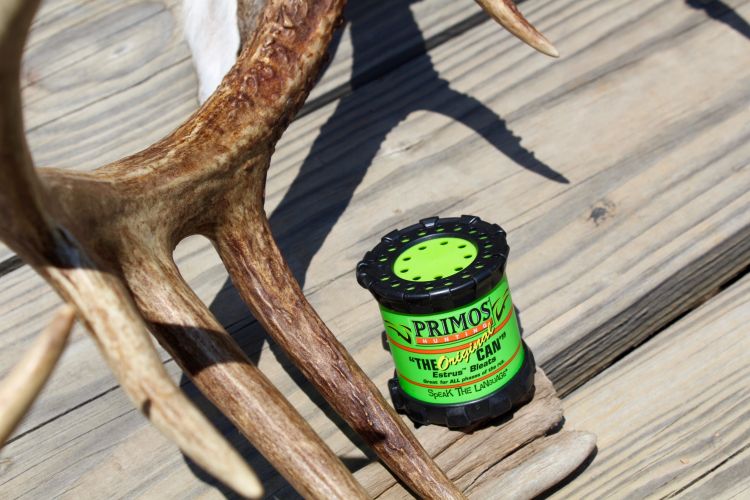
“I don’t go to the woods without the little Primos Original Can bleat call,” he said. “Most of the bucks I’ve killed have responded to this call, and a lot of them that have I let walk. Sometimes more than one buck will respond.”
But using the bleat call correctly is important. Ben does two quick, long bleats, then waits about 30 seconds and does one more long bleat. If he doesn’t see a deer come and check it out within 10 minutes, that usually means a buck is not in hearing range.
Ben and his family also rely a lot on past experience, and a good number of game cameras to see what’s going on in the woods. They don’t actually get out and scout trails in the deers’ territory, because they feel like the less intrusion there is, the more chances of the deer moving about freely.
Keep it simple
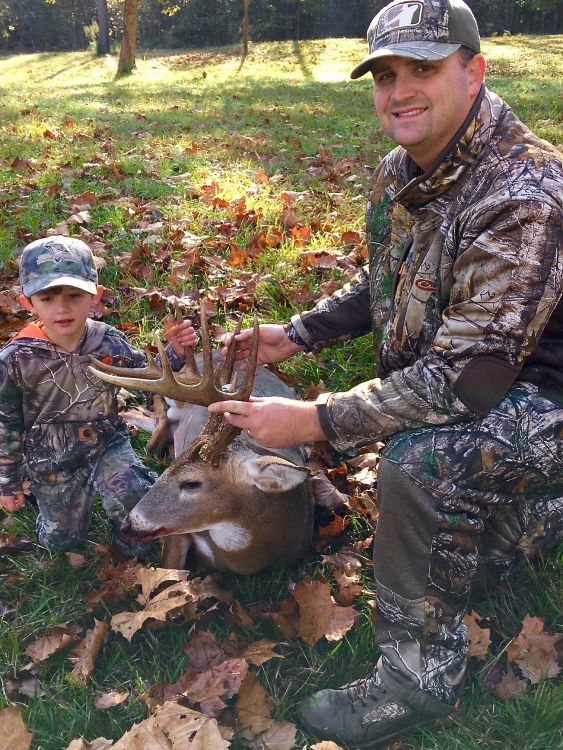
When it comes to having plenty of big deer to hunt, Jones said it’s pretty easy: You’ve got to be willing to let some good young deer walk, and you have to actively manage the number of does — because too many does will scatter the big bucks.
He uses a variety of guns. His “go-to” big deer gun is the Browning .300 Win Mag, and he shoots 180-grain Federal Fusion bullets.
He also has a .243 that he takes with the boys, and loves to shoot his .444 Marlin primitive weapon, sometimes even in the regular gun season. When he bowhunts, he uses a Hoyt Vector with a long draw to fit his tall frame. He shoots Rage Hypodermic arrows, and doesn’t change equipment very often.
Other than that, he keeps things pretty simple. He carries a couple of pairs of gloves in his backpack, along with two or three headlamps that allow him to remain hands-free in the dark. He carries a grunt call, but uses it sparingly. The Joneses have a variety of stands on their property, from some of the old pipe-leg stands his grandpa put up to newer box stands and a few hand-made lean-to stands.
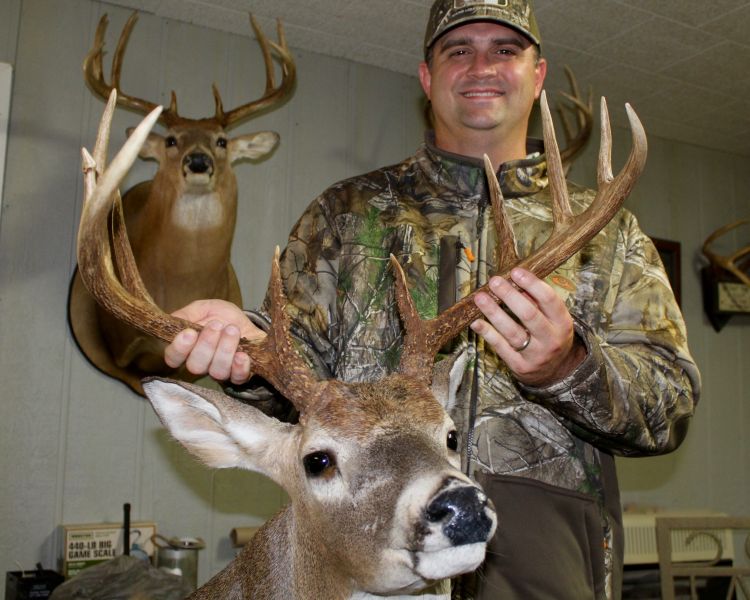
“You have to have gear that you are comfortable with and confident in,” Jones said. “Other than that, don’t overcomplicate it. The most important things are what we’ve talked about: Get in the woods, learn as much about the deer and their habits as you can and just have fun.”
Finding an acorn
The defining identification characteristic of Ben’s big 10-point was an “acorn“ tip on one of the right beams. An acorn tip occurs when a buck damages an antler while it’s still in velvet. The soft tip breaks or is injured, and as the tissue heals, it produces an “acorn.”
Baseball and bucks
Hunting isn’t the only sport Ben Jones has excelled at since he was a youngster. He was an excellent baseball player, going from youth all-star to high school all-state at Ouachita Christian School, and then to college ball at the University of Louisiana-Monroe.
As a junior, Ben was drafted by the New York Yankees and pursued the big league dream for several years.

“Baseball at the higher levels is a tough sport,” he said. “You fail a lot, and you learn to deal with it and bounce back. You don’t accept it, but you deal with it.
“To be honest, it’s a lot like hunting. Sometimes things go right. Sometimes they don’t. It feels bad when you strike out. It feels good when you hit a home run. You just have to feel your way along and keep working. It takes a lot of things working in your favor to be successful in the moment.”
So which was is more exciting, playing ball or dropping a hammer buck? Ben’s dad, Scott, has the answer.
“I can tell you this,” Scott said. “Ben never hyperventilated over hitting a home run. He never had to drop everything and call me when he won a baseball game. But when he shoots a big deer, he can’t breathe for a few minutes and he really gets pumped.”
There’s even another level of excitement added now that he’s hunting with his boys.
“Oh, as excited as I get killing a big buck, it was twice that exciting when Brooks got his first buck, and I’m sure it will be the same when Shepard gets his.”
Following the deer trail … backwards
While Ben Jones hadn’t seen any previous evidence that the big 10-point he killed last November even existed, the monster left a trail of other hunters watching and hoping for a glimpse in daylight hours. An unmistakable acorn tip on one of the deer’s antlers left no doubt to its identity.
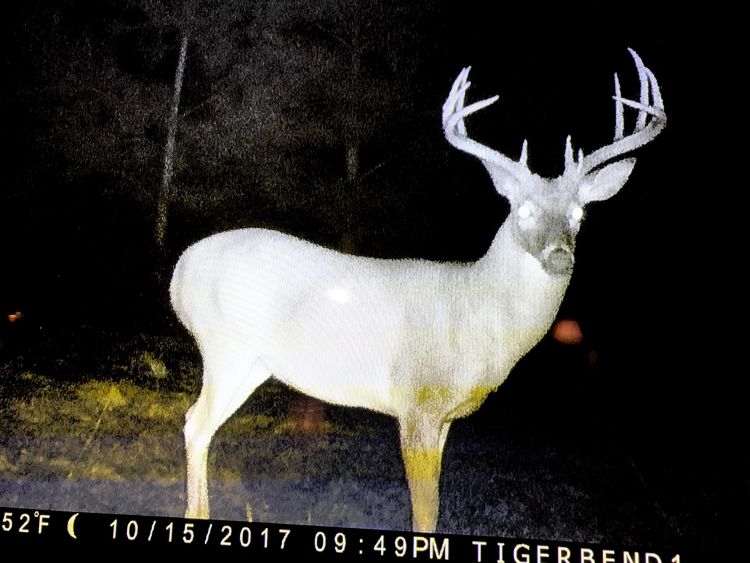
As technology infiltrates every aspect of our lives, and almost every event is recorded in some form or fashion, the same thing is happening in deer hunting. The big buck that Jones harvested had been hot and heavy on the trail of does, and it left irrefutable evidence of its travels on camera. Most hunters already figure that big bucks move a lot during the rut — but just how far they move continues to amaze them.
“I know the bucks move a lot during the rut, but this deer made his way through a 4-mile wide area his last few days,” Jones said. “The most remarkable evidence was the fact that he showed up on a game camera at my cousin Dan Preaus’ stand just a couple of hours before he showed up in the shooting lane at my stand. Those two stands are 2 ½ miles away from each other.”
After further examination of another camera on Ben’s club, the big deer had made at least two trips across Ben’s shooting lane the night before it was shot. And the same deer also was spotted on camera even further away on a neighboring hunting club days before.
“The norm for us with a big deer is that we see him often on camera, usually for more than one year as he grows. But this one? I had no history of him. We did everything right, but to be honest, this one was just luck,” he said. “It was a case of being in the right place at the right time.”
It’s a family tradition
Ben’s dad, Scott Jones, knows about being in the right place at the right time, too. When he was just a teenager, he often went hunting with his dad and a group of friends. One day a neighbor told them about several big bucks running around in his pasture.
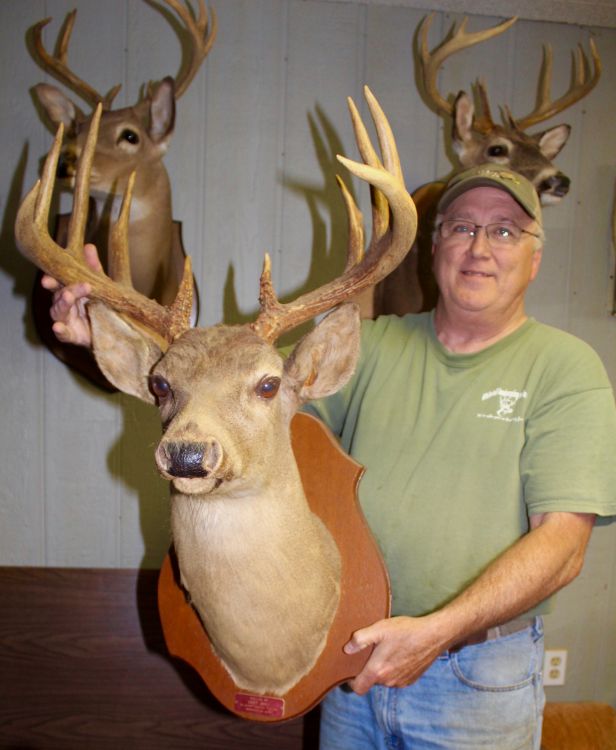
The group gathered and plotted a plan to cover the pasture, and sent Scott with his 16-gauge shotgun to a little patch of woods where he found a cozy spot in a treetop to hide out.
A few minutes later he heard something rustling the leaves behind him, and figured it was just a possum. He had heard possums in the woods before, but he’d never seen or heard a deer. Finally he turned around and looked, and there, just 20 yards away, was a massive thick-beamed 10-point staring right at him. Both of them were stunned, but Scott managed to fire off two rounds at the deer.
He missed, but the deer only went a few steps. Apparently it had never seen a hunter, either. Scott chambered his last shell — a slug — and hit the buck squarely behind the shoulders and dropped it.
That mount still hangs in their camp, clearly labeled, “Killed by Scott Jones in Jerry Burgess’ Pasture. November 26, 1967.”